
 TR
TR
 DE
DE
 RU
RU
 AR
AR
Vehicle Efficiency
Transport operations from different supplier points can be managed through a single vehicle and planned route.

The Milkrun system is a modern logistics model that plans material flow between manufacturers, suppliers, regional hubs, and delivery points from a single center while providing route optimization and vehicle capacity management.
The collection route starting from manufacturing companies is managed in a controlled way through consolidation and storage centers, regional hub operations, and sales points.
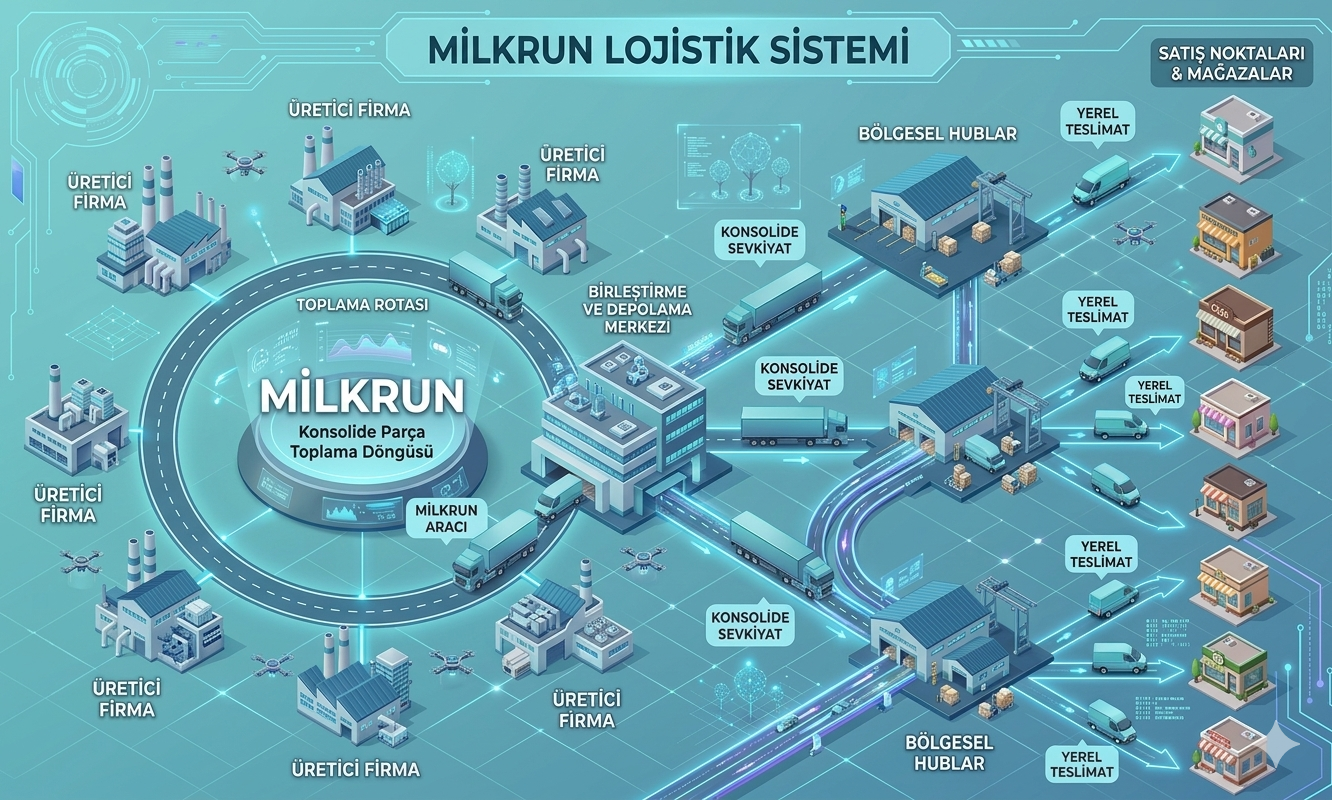
Milkrun is a logistics supply method that enables manufacturers to manage material flow with supplier companies in a more planned, faster, and more efficient way.
The system handles daily material needs, packaging data, palletizing process, vehicle capacity, and route planning together to manage transport operations in a more controlled way.

The Milk-Run system processes incoming material data and turns packaging, palletizing, route creation, and operation tracking into a structured workflow.
Material files sent by the company are transferred into the system.
Materials are packaged, and pallet plans are created with suitable algorithms.
Suitable vehicles, collection points, and distribution routes are determined.
The process is managed through reporting, confirmation, and notification steps.
The Milkrun model provides advantages in cost, time, and environmental impact by enabling transportation operations to be carried out in one planned trip with high occupancy rates.
Transport operations from different supplier points can be managed through a single vehicle and planned route.
As total distance and vehicle count decrease, it contributes to reducing operation-based CO₂ emissions.
High stock requirements and storage costs can be reduced thanks to short-term and regular material flow.
With daily planning and automatic notification structure, operation processes become faster and more traceable.
The Milkrun system can work with different routing techniques according to the daily operation structure and the status of the pallet pool.
It works through predefined master data and fixed routes. Materials in the daily file are received, packaged, and assigned to suitable static routes.
Pallets that cannot be assigned to a static route are collected in the pool. New dynamic routes are created according to pallets, suppliers, and unloading points in the pool.
Authorized users can create manual routes based on start time by selecting specific pallets in the pool. This structure provides more controlled special planning.
A preliminary plan can be prepared by receiving packaging data from the SAP system. After the approval process, the data is included in the daily plan and transferred to the operation flow.
Milkrun screens can be designed with manageable structures such as users, roles, groups, permissions, language support, localization, and dynamic rules.
Unauthorized users can be allowed to access only specific areas. While admin users can access all menus, other users’ transaction areas can be limited according to role and permission structure.
Special needs outside the Milkrun plan and daily order confirmations can be tracked through the system.
Material or empty box requests needed outside the factory plan can be opened. Requests can be sent to relevant suppliers and authorized users by email.
Suppliers can review and approve the material and quantities in the daily order. They can provide information with explanations in case of missing or delayed shipments.
You can contact us for detailed information about Milk-Run transportation, route optimization, and material flow management.